
This page outlines some of the topics we work on in the lab.
Perceiving an uncertain world
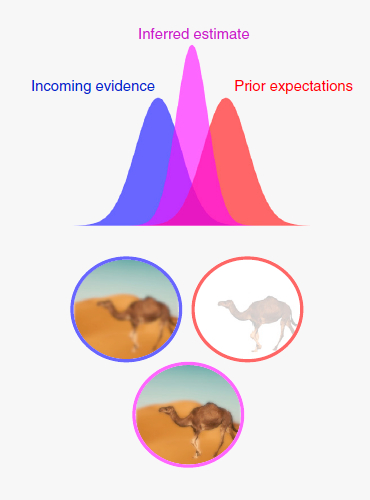
Our brains have to generate accurate representations of the extracranial world. But the information arriving at our senses is inherently ambiguous and uncertain. In the lab we study how perceivers manage and represent uncertainty in what they are perceiving. A major focus is on the idea of prediction – and much of our work considers how the brain uses internal models based past experiences to control perception and awareness.
Examples:
Yon, D., & Frith, C.D. (2021). Precision and the Bayesian brain. Current Biology.
Olawole-Scott, H., & Yon, D. (2023). Expectations about precision bias metacognition and awareness. Journal of Experimental Psychology: General.
Press, C., Kok, P., & Yon, D. (2020). The perceptual prediction paradox. Trends in Cognitive Sciences.
Yon, D., et al (2018). Action sharpens sensory representations of expected outcomes. Nature Communications.
Calibrating uncertainty through social interactions
One of the major ways our minds and brains might deal with the uncertain worlds we find ourselves in is to share and compare our experiences with other people.
In the Lab, we are interested in understanding how we learn about uncertainty and confidence by interacting with other people – and how the social world might enhance or distort our awareness of the world and ourselves.
Examples:
Andreassen, E.R., Frith, C.D., & Yon, D. (2026). Public communication alters private confidence. Current Biology.
Barnett, B., & Yon, D. (2026). Joint perception biases subjective awareness reports. Journal of Experimental Psychology: General.
Learning about an uncertain world
The outside world is not always stable. As a result, our brains have to strike a balance between learning from new data and relying on existing models about how the world works. We are interested in how our minds strike this balance, and how learning controls different aspects of perception, action and belief.
Examples:
Yon, D., et al (2023). Stubborn predictions in primary visual cortex. Journal of Cognitive Neuroscience.
Yon, D. (2020). Prediction and learning: Understanding uncertainty. Current Biology.
Yon, D., de Lange, F.P., & Press, C. (2019). The predictive brain as a stubborn scientist. Trends in Cognitive Sciences.
Theory in the mind and brain sciences
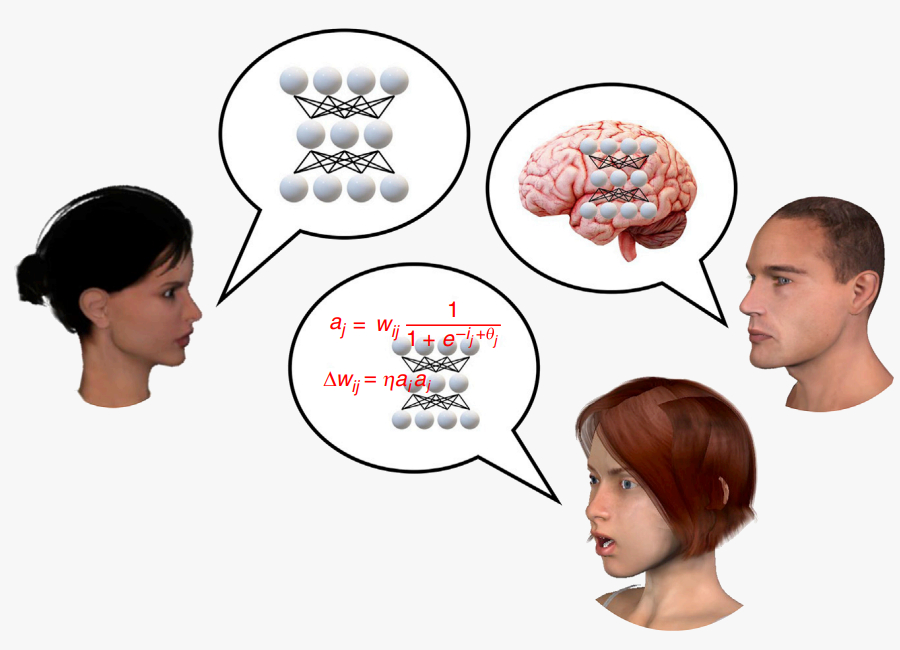
Alongside our experimental and theoretical work on perception, action and belief, a strand of work in the lab also looks at conceptual issues in cognitive science and cognitive neuroscience. This includes thinking about how scientists can connect cognitive, philosophical, computational and biological approaches to studying the mind – and thinking about what makes a good scientific theory.
Examples:
Yon, D., & Heyes, C. (2024). Social learning in models and minds. Synthese
Yon, D., Heyes, C., & Press, C. (2020). Beliefs and desires in the predictive brain. Nature Communications.
Press, C., Yon, D., & Heyes, C. (2022). Building better theories. Current Biology.